Evaluation of the California Tax System

                                                          By Jiazhen “ Joan” Chen
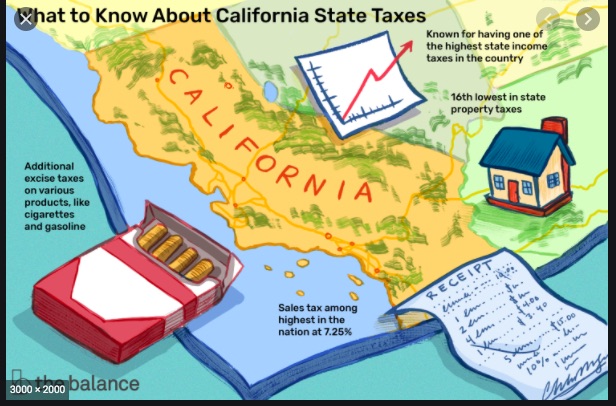
The Taxation System

            The term tax serves as a firm reminder to people that they have been given personal and mandatory responsibility to divert a certain amount of their wealth—past, present, or future—to become  part of the revenue required by institutions and units of government performing public services (Brimley, Verstegen, & Garfield, 2012, p. 114).  All citizens owe taxes.  The benefits of government services are shared by all of the nation’s citizens in varying degrees,  depending on their needs. A good tax system provides that every person and every business be  required to pay some tax to government (Brimley, Verstegen, & Garfield, 2012, p. 115).  

            Because everyone pays taxes, as a matter of simple justice and fairness, a good tax system distributes the burden it creates among all its citizens in an equitable manner. The notion of equity  incorporates both horizontal and vertical dimensions. First, horizontal equity requires that those  taxpayers in similar circumstances should be treated equally. Second, vertical equity requires  that taxpayers in different circumstances should be treated according to those differences (Brimley, Verstegen, & Garfield, 2012, p. 115).

            It is necessary for education to be financed by government, given its capability of collecting resources from the private sector and  distributing them equitably among institutions in the public sector.  Historically education has been  financed largely at the local level. In the opinion of many, this fact creates one of the more difficult  problems with which educators must concern themselves—providing equitable school programs and  creating equitable tax burdens across the state within the framework of the local property tax system (Brimley, Verstegen, & Garfield, 2012, p. 116).

The Five Basic Criteria For a Good Tax System

  • Equity and Ability-to-Pay

Whether a tax system is fair depends on how it treats all individuals, particularly the rich and the  poor. If the greatest percentage of the tax burden falls on low-income individuals, then the tax is  regressive and considered unfair. Taxes are considered fair if they contain features of progressivity with the largest percentage falling on individuals with higher incomes system (Brimley, Verstegen, & Garfield, 2012, p. 117).

  • Adequacy of Yield

            Maintenance of the extensive services of government requires large amounts of tax revenue.  Therefore, it is important that taxes be applied to productive sources. There is no point in complicating the system by the addition of taxes that have little individual potential for yielding revenue  in substantial amounts (Brimley, Verstegen, & Garfield, 2012, p. 117).

  • Cost of Collection

            To the extent possible, taxes should have relatively low collection and administrative costs for  both the government and the individual. Government institutions are interested in the amount of  net revenue available to them rather than the gross amount of dollars collected (Brimley, Verstegen, & Garfield, 2012, p. 117).

  • Predictability and Stability

   Governments depend on taxes for funding; consequently, revenues that are consistent, dependable are preferred to those that change from year to year. The predictability of consistent or  stable revenue streams allow governments to forecast future income and expenditures with some  accuracy and assure that revenues will be available to meet their needs (Brimley, Verstegen, & Garfield, 2012, p. 118).

  • Difficulty to Evade

          It is a distinct violation of good taxation theory to pass  tax laws that have gaping loopholes whereby many citizens or businesses can escape paying their  share of the tax burden. Such unfair exclusions make those who contribute pay more than their  fair share of the costs of government services (Brimley, Verstegen, & Garfield, 2012, p. 115).

Different Types of Taxes

Property Tax

            A property tax is levied against the owner of real or personal property for individuals and businesses. Real property is not readily movable; it includes land, buildings, and  improvements. It is usually classified as residential, industrial, agricultural, commercial, or  unused (vacant). Personal property is movable; it consists of tangibles (such as machinery, livestock, crops, automobiles, jewelry and recreational vehicles) and intangibles (such as money,  stocks, and bonds) (Brimley, Verstegen, & Garfield, 2012, p. 130).

Income Tax

            The personal income tax is usually a progressive tax levied on the income of a person received  during the period of one year. It is the basis of the federal financial structure, but is also used to a  lesser degree by nearly all of the states as a funding source (Brimley, Verstegen, & Garfield, 2012, p. 127). Individual income is  derived from salaries, dividends, sale of assets, interest, and gains. There are both individual and  corporate income taxes (Brimley, Verstegen, & Garfield, 2012, p. 134).

Sales Tax

            A sales tax is a levy imposed on the selling price of certain goods and services. It is generally  applied at the retail level rather than on wholesale operations. If food and other necessities are  subject to a sales tax, the tax becomes regressive. The sales tax is used most often at the state  level of government although it is sometimes applied at the county and city levels. It produces  large amounts of revenue and is one of the most transparent ways to collect taxes, but its use  without exclusion of necessary goods and services tends to overburden poor families (Brimley, Verstegen, & Garfield, 2012, p. 129).

Excise Tax

An excise tax, also called a sumptuary tax, is sometimes imposed by government with the primary purpose of helping to regulate or control a certain activity or practice not deemed to be in  the public interest (Brimley, Verstegen, & Garfield, 2012, p. 134).

Severance Tax

            Severance taxes are defined by the Department of Commerce as “taxes imposed distinctively on  removal of natural products—e.g., oil, gas, other minerals, timber, fish, etc.—from land or water  and measured by value or quantity of products removed or sold.”  This tax is imposed at the  time the mineral or other product is extracted (severed) from the earth. Levies can also be made  for the privilege of removing a given commodity from the ground or from water. These levies are  sometimes called production, conservation, or mine (or mining), and occupation taxes (Brimley, Verstegen, & Garfield, 2012, p. 134).

Evaluation Table of the Tax System in California

 StableEasy to CollectEquitableAdequateEasy to Evade
Property TaxYesYesNoYesNo
Income TaxYesYesYesYesNo
Sales TaxNoYesNoYesNo
Excise TaxNoNoNoNoYes
Severance TaxNoNoYesNoYes

Highest-ranked Tax

Income tax ranks highest becauseincome is a good measure of an individual’s economic well-being or “ability” to  pay. Using income as a measure of fiscal capacity creates a fair system of tax burdens on society.  Equals—those persons with similar incomes—are taxed equally. Unequals—those persons with  different incomes—are taxed differently. As the cornerstone of the tax system, all other taxes are  assessed in relation to the impact they have on a person’s income (Brimley, Verstegen, & Garfield, 2012, p. 134).

An advantage of using income as a measure of economic well-being is  that it can be measured and taxed over a specific period of time. If it fluctuates, so does the tax  that is paid. Income is also relatively easy to track, although sometimes it can be hidden in the  form of tips, trades, or exchanges. Another advantage is that all taxes are paid out of income (Brimley, Verstegen, & Garfield, 2012, p. 134). Income  taxes provide a substantial yield, making it a key approach in funding government programs and  services (Brimley, Verstegen, & Garfield, 2012, p. 129).

Lowest-ranked Tax

            Excise tax ranks lowest because for this kind of  tax, the collection of revenue is only a secondary purpose of the tax. Thus, funding is usually  comparatively small, and there is little room for expansion or extension of the tax (Brimley, Verstegen, & Garfield, 2012, p. 134).  In general, sumptuary taxation receives little support from tax theorists. The fact that  sumptuary taxes do, in fact, produce revenue often leads to a situation in which a  governmental unit in need of funds is tacitly encouraging an activity which tax legislation sought to discourage (Brimley, Verstegen, & Garfield, 2012, p. 134).

Best Tax for Education

Property tax is the best tax for education because of its desirable traits. It operates as a direct tax. It is easily collected. It is almost impossible to avoid paying. It is highly productive. It is highly visible. It is relatively stable and can provide a reliable source of revenue.  It is regulated and controlled by local boards of education within state law (Brimley, Verstegen, & Garfield, 2012, p. 130-131).

Property taxes were the first kind of school taxes, and they still constitute almost the complete local tax revenue for schools. The states have long based their local school revenue systems on a property tax. For a  long time, the property tax seemed to be reasonably satisfactory as an education financing mechanism. The property tax at the  local level has proved to be a good and reliable source of revenue for operating schools and providing many other services of city, town, and county government (Brimley, Verstegen, & Garfield, 2012, p. 130).

Equity and Adequacy Issues

Even though the property tax has served the schools well for many years, it has always faced  some criticism. The property tax no longer represents the fair or  equitable measure of taxpaying ability that it did years ago (Brimley, Verstegen, & Garfield, 2012, p. 131). The finance problems encountered by most urban centers illustrate some of the deficiencies of the property tax.  Cities generally have higher percentages of high-cost students to educate—such as students with disabilities, low-income students and English language learners (Brimley, Verstegen, & Garfield, 2012, p. 132). Described by many as the most regressive, oppressive, and inequitable tax of  all, it has lost much of its traditional popularity as a source of revenue for schools.  Many segments of society—taxpayers,  educators, and economists—have protested both its use and particularly its extension (Brimley, Verstegen, & Garfield, 2012, p. 132).   

A single tax, regardless of its basic strengths or utility, can never be fair for all citizens of  a taxing unit. Taxation theory requires diversification with a broad tax base—such as income,  sales, and property—so that an individual’s “escape” from a particular kind of tax does not mean  complete exemption from paying a tax of any kind. Diversification of taxes is important, but  simplicity is equally necessary in any good tax system. Taxpayers cannot be expected to support intricate and complicated tax laws they cannot understand (Brimley, Verstegen, & Garfield, 2012, p. 116-117).

References

Brimley, V.R., Verstegen, D. A. & Garfield R.R. (2012). Financing education in a climate of change (12th edition). Pearson Education Inc.
Proposition 98

Summary of the Legislation, Proposition 98 (1988)

Based on Wikipedia,  California Proposition 98 requires a minimum percentage of the state budget to be spent on K-12 education. Prop 98 guarantees an annual increase in education in the California budget.[1] Prop 98, also called the “Classroom Instructional Improvement and Accountability Act,” amended the California Constitution to mandate a minimum level of education spending based on three tests. Test one, used only for 1988 to 1989, requires spending on education to make up 39% of the state budget. Test 2, used in years of strong economic growth, requires spending on education to equal the previous years spending plus per capita growth and student enrollment adjustment. Test 3, used in years of weak economic growth guarantees prior years spending plus adjustment for enrollment growth, increases for any changes in per capita general fund revenues, and an increase by 0.5 percent in state general funds.

Voters approved Proposition 98 in 1988.  Based on EdSource (2006), when voters approved Proposition 98 as an amendment to the California Constitution, they sought to guarantee public schools and community colleges a level of funding that would at least keep pace with growth in student population and the personal income of Californians and at best increase the amount schools receive. The calculation of the Proposition 98 minimum is based on the principle that K-14 education should receive at least the same amount as it did the previous year, adjusted for changes in enrollment and per capita personal income. The constitution allows state officials to temporarily reduce education funding below the minimum guarantee under two conditions. One is when state General Fund revenues grow less than personal income; the other is when two-thirds of the Legislature votes to suspend the guarantee for a given year. In both cases, the amount saved in that year must begin to be restored to the minimum guarantee level in the next year that state General Fund revenues grow faster than personal income. The Legislature always has the option of funding K-14 education above the minimum guarantee. When it does so, however, it also raises the base amount from which the guarantee is to be calculated the following year.

Relevance on Education

Since 1988, Proposition 98 has been constitutionally governing the amount of funding provided to public schools and community colleges in California.  According to Kapphahn (2017), Proposition 98, a measure on the November 1988 ballot, was intended to increase state funding for schools. The proponents of Proposition 98 argued that school funding at the time was too low and associated state budget decisions too political. Approved by 51 percent of voters, Proposition 98 added certain constitutional provisions setting forth rules for calculating a minimum annual funding level for K–14 education.

According to PPIC (2020), Proposition 98 has shifted state higher education funding toward the community colleges. Proposition 98 (enacted in 1988) requires that a minimum share of the state budget be allocated to K–14 education; community colleges usually receive around 11% of this funding. Before the passage of Proposition 98, each higher education system received a roughly equal percentage of state funding. By 2015–16, the UC and CSU systems were sharing about 40% of the state funding, while 60% was allocated to the community colleges.

Discussion on Equity

Education should be financed and operated equitably, but this cannot and  should not be done with complete equality, because of the many differences in the abilities and  needs of students and districts (Brimley, Verstegen, & Garfield, 2012, p. 53). Emphasis on excellence has resulted in differences of opinion about equity. Some believe additional resources should be targeted to guarantee quality. Those who espouse excellence as a priority see the main goals of financing education to be the attainment of excellence. Others feel  that states have yet to reach fiscal equity and that the priority still rests there. Still others call for  both an equality of a quality education for all children and youths (Brimley, Verstegen, & Garfield, 2012, p. 55).

According to PPIC (2020), after Proposition 13 passed in 1978, the state’s community colleges—which unlike UC and CSU relied partly on property taxes—saw a sharp reduction in their share of state and local support. Ten years later, voters passed Proposition 98, which guaranteed K–12 schools and community colleges a minimum percentage of the General Fund and property tax revenue. Proposition 98 guarantees that K–12 schools and the community colleges get about 40% of these allocations—and about a tenth of that share goes to the community colleges. Some have argued that Proposition 98 acts as a funding ceiling for K–12 schools and community colleges, but it also serves as a floor.

UC and CSU lack the same funding protection. While many budget areas outside of higher education are at least partially protected by dedicated funding streams, court orders, or matching federal funds, UC and CSU are vulnerable when state revenues decline. The universities have faced disproportionately large cuts in their general fund allocations during times of economic hardship. From this vantage point, a funding floor—even one that doubles as a ceiling—is preferable to a funding drop-off.

The three higher education systems also receive indirect forms of state support such as Cal Grants, fee waivers, and middle-class scholarships. Grant aid has increased for students at all institutions of higher education in California. Our best estimates suggest that community college students receive slightly more of these state funds (41% of the total in 2011‒12), than UC students (40%) and much more than CSU students (18%).

The debate over higher education funding could benefit from a clearer understanding of how the pie is divided. But the most important issue for the state’s young people is that the pie is not keeping pace with demand. Our four-year colleges have record numbers of applicants and the shares of students who are academically qualified to attend them have increased. The future prosperity of Californians and their state depends on access to higher education. To address these issues, policymakers need to focus on improving vocational programs and pathways from community colleges to four-year colleges and improving access and enrollment at UC and CSU.

References

Brimley, V.R., Verstegen, D. A. & Garfield R.R. (2012). Financing education in a climate of change (12th edition). Pearson Education Inc.

EdSource. (2006). Proposition 98 guarantees a minimum level of funding for public schools. In EdSource. EdSource.

1988  California Proposition 98. (2020).In Wikipedia. Retrieved from https://en.wikipedia.org/wiki/1988_California_Proposition_98

Kapphahn, K. (2017, January 18). A historical review of Proposition 98. LAO. Retrieved from https://lao.ca.gov/Publications/Report/3526

Proposition 98. (2020). Public Policy Institute of California. Retrieved from

https://www.ppic.org/blog/tag/proposition-98/

The First School where I taught in USA

The first school where I taught in USA was called Chesney Elementary School. At the beginning I was assigned to teach 5th grade . I found myself struggling even though I had taught English as Foreign Language in universities in China before and even though I had been also trained teaching in elementary school in the teacher college at Queen’s University. I was assigned a mentor who was the grade chair for 5th grade. However, she was not available to support me at all. Things started to change since I requested to switch to teach kindergarten in the same school. I got lots of support from the kindergarten teaching team. I was assigned a peer mentor. She was always available to help me when needed. The grade chair for kindergarten was also very supportive. With such effective mentorship and support, I have turned into a great kindergarten teacher since then.

Positive Discipline

For twenty-five years, Positive Discipline has been the gold standard reference for grown-ups working with children. Now Jane Nelsen, distinguished psychologist, educator, and mother of seven, has written a revised and expanded edition. The key to positive discipline is not punishment, she tells us, but mutual respect. Nelsen coaches parents and teachers to be both firm and kind, so that any child–from a three-year-old toddler to a rebellious teenager–can learn creative cooperation and self-discipline with no loss of dignity. Inside you’ll discover how to

• bridge communication gaps
• defuse power struggles
• avoid the dangers of praise
• enforce your message of love
• build on strengths, not weaknesses
• hold children accountable with their self-respect intact
• teach children not what to think but how to think
• win cooperation at home and at school
• meet the special challenge of teen misbehavior

Please refer the following link for the more detailed info for this book, Positive Discipline.

https://www.google.com/search?sxsrf=ALeKk00aUjjve-ipieRHwneG3PLwgPOa9A%3A1582662621762&source=hp&ei=3YNVXvinLIri-gTk-ISQCg&q=Positive+discipline&oq=Positive+discipline&gs_l=psy-ab.3..0l10.150221.163509..164247…10.0..0.101.2089.25j1……0….1..gws-wiz…..6..35i362i39j0i131j0i10j0i131i10j0i70i249.Er0nhl3GeRY&ved=0ahUKEwi4ivjaxe3nAhUKsZ4KHWQ8AaIQ4dUDCAg&uact=5

Self-care and Teaching

After teaching 15 years, I reflect that self-care is important for teachers. I have to take good care of my body and mind so that I can help students learn and grow more effectively. I have to keep the energetic and uplifting voice so that I can motivate students better. I have to maintain a healthy strong outlook so that I can manage students’ behavior more consistently and positively. Here I am going to share some online teacher self-care tips as shown in the link below.

https://momentousinstitute.org/blog/teacher-tips-self-care-strategies

The Story of an Educator

Since 7th grade, I started to dream of becoming a teacher. In 1991, I started to teach as a lecturer teaching English as Foreign Language in Petroleum University in China. A year later, I was promoted as the “Grade Chair” for teaching freshmen students in the university. In 2000, I left China and immigrated to Canada. I worked hard to try to become a teacher again in Canada. I did my graduate school in University of Toronto. I did my teacher college at Queen’s University. However, I could not find a teaching job in Canada. Instead, I found a teaching job in Georgia, USA. I ended up teaching kindergarten as a classroom teacher for three years there. Later on , I also taught Mandarin Chinese as foreign language in the middle/high schools there for two years. Then, I stayed at home for my two sons for three years. As a matter of fact, I missed teaching during those years while I stayed at home. When I moved to California, I spent one year teaching kindergarten at Child Development Center by Stonegate Elementary School in Irvine. Since 2019, I have started to study as a doctoral student in Educational Leadership at Concordia University Irvine. My dissertation would be focused on Social Emotional Learning. I am also working as a research assistant for our EDD office at CUI. My career goal after graduating from my doctoral study is to become either a professor or a researcher. In my blog, I will continue to share my teaching and learning journey.

Design a site like this with WordPress.com
Get started